Tuesday, September 17, 2019

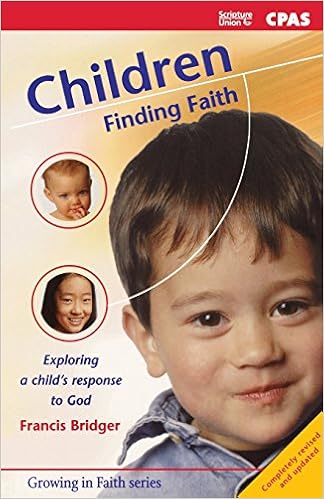
Children Finding Faith
Francis Bridge
Scripture Union (May 1, 2000)


It has been a question in my mind (now that I have my own kids), about when we determine that a child is considered ‘converted’ or having put their faith in Jesus.

John Bridger’s emphasizes on the necessity to look at a child’s process of physical and emotional development for them to be able to understand the Gospel and responding appropriately.

The book started with illustration of 2 children from very different homes (one with supportive and encouraging parents, and another one with single parent’s family whose presence is unwelcome) , how they grow in their different stages of childhood from infancy to toddlers to school-going age, and what kind of responses we expect from the 2 kids at each stage considering their background respectively.

Useful excerpts from the book:

“Believing at the junior age, then, is a very complex business. The evangelist who does not recognise the developmental characteristics of the phase will end up with one of two results: (a) children committing themselves to a message they have not understood, because they want to please; or (b) children who seem to accept what is said but whose capacity for future scepticism has been significantly increased” – Chapter 4 The blossoming Faith – Junior years, Pg 89

“John Westerhoff: Faith stages

Experienced faith >> Affiliative faith >> Searching faith >> Owned faith

Westerhoff locates the point of conversion overwhelmingly in late adolescence or early adulthood. This is no accident. His developmental structure requires the sequence of faith stages must be gone through before conversion can take place. By definition, the act of surrender must come as a result of dissatisfaction by former affiliative faith and the desire to find something personally meaningful. This cannot happen until adolescence at the earliest.” – Chapter 7 Faith development and conversion , Pg 142

“… Commitment to the group is often the highest form of commitment a child can make outside his or her immediate family relationships. We should not be looking for responses which are characteristically adult but for those which are realistically appropriate to child development.

This goes a long way to explain 2 things common among children’s missions and clubs. On one hand, there are frequently large numbers of children who make profession of faith or who want Jesus to be their friend; on the other hand there is often a high subsequent dropout rate. Children who are initially full of enthusiasm fall away. Those who have been faithful in attendance become less regular. Others are never seen at all between missions. (This is especially true of church based mission which run every summer.) When this happens it is tempting to think that the child or children in question never really make a commitment of faith. ‘If they were really disciples,’ we say to ourselves, ‘they would not have fallen away. Therefore they must never have been true Christian in the first place’.

The fact is that they probably never were – that is, as long as being a true Christian is defined in terms of an adult conversion experience’ – Chapter 7 Faith development and conversion, Pg 145

“We need to be clear, finally, that each of the stages described by Westerhoff is a stage of faith. It is not a question of a child’s suddenly reaching faith at the final stage. All the way through, faith has been at work. As Westerhoff says: ‘Let us never forget that… Christ died for us all, and no matter what style of faith we possess none are outside his redeeming grace.” – Chapter 7 Faith development and conversion, Pg 146

“…the goal of evangelism must be to enable a child to accept a new set of meanings based on the idea of a relationship with Christ. These do not have to be understood in adult terms. The set of meanings can be geared to the appropriate stage of development so as to take account of the factors discussed …in speaking to junior age children, for example, we shall be concerned to couch this new set of meanings in concrete terms. In younger groups we might major on the idea of God as loving parent and so on.” – Chapter 7 Faith development and conversion, Pg 147

“Theologically, then, conversion is God’s act from beginning to end. This may seem to conflict with the emphasis of faith development models but in reality it does not. For God’s grace flows both through natural (God-created) channels and through the momentary intervention of the Holy Spirit. We can therefore say that the development of faith through stages over time and the immediate crisis of conversion arise from the same source – the living God.” – Chapter 7 Faith development and conversion, Pg 155

“The theological writer John Inchley made a telling point when he said: ‘It is sad to hear Christian parents declaring – “John is saved, though Mary isn’t and we are not quite sure about Bill.””

This kind of conversation goes on regularly in Christian households. It is based on the view that no child, even from a believing background, can be counted as a member of God’s kingdom until he or she has made an open conscious declaration of faith. It would seem that the faith of parents counts for nothing.

Such a view has serious implications for the message Christian parents and workers give to children. The aim has become evangelism rather than nurture. Everything is geared up to conversion. It is assumed that the child of Christian parents need to ‘get saved’ in exactly the same way as would a child from an unbelieving home. The pastoral consequences of this can be horrific as the child senses that he only can please his parents by going through some ‘conversion’ experience which somehow makes him acceptable to them and to God. It is hardly surprising that later years see so many casualties of faith.” – Chapter 7 Faith development and conversion, Pg 159

“The implication for us is clear: we must count children of Christians as members of God’s kingdom until such time as they refuse God’s covenant promise. This means that it becomes more fitting to think of nurture than evangelism for such children. They have to be encouraged to appropriate and articulate the blessing they already possess by virtue of their status as covenant children. Once we realise this we free ourselves as parents and evangelists from the enormous pressure to bring about some kind of conversion experience for children who, theologically, are already accepted by God. No less importantly, we also liberate our children from fear, allowing them to become what God has for them: heirs of his covenant promise in Christ.” – Chapter 7 Faith development and conversion, Pg 161

I walked away from this book, knowing better of my role as a parent and a Sunday school teacher in my church: that the emphasis of nurture is just as important as the emphasis of conversion.

Wednesday, May 22, 2019

DESIRE - John Eldredge

DESIRE
John Eldredge
Publisher: Thomas Nelson, 2007


Chapter Ten: Entering More Deeply into Desire. 

The path to a clearer knowledge of our desire depends on how we've been handling it. Those who have buried desire beneath years of duty and obligation may need to give all that to rest so that their hearts can come to the surface... do nothing unless it reflects your true desire. Remember the Pharisees -- their religious activities deadened them to the point that they couldn't even recognize God when He stood before them. When our deepest treasure becomes our most dutiful burden, it really kills our hearts. You might even need to give up going to church for a while or reading your bible. I stopped going to church for a year: it was one of the most refreshing years of my life. I hadn't abandoned God, and I very much sought out the company of my spiritual companions. What I gave up was the performance of having to show up every Sunday morning with my happy face on. I suggested something similar to a young woman who had really lost the joy of her faith. A few weeks later she wrote to me, "I actually had a desire to read the Bible and pray without its being a set time or an guilt trip! That's never happened before!"

This is probably one of the boldest advice, yet most practical I find (though radical). I do encourage people to stay away from ministry, or from church attendance for a while. Not for discouraging/going against Hebrews 10:25, but for the purpose of examining our own motivation in the activities we always took for granted. Many a time, I found myself yearning for people's praises, or people's approval. Somehow, when I distance myself from the routine, it allowed me to seek God's approval, His purpose, - His and Him alone.

Worship- The Heart's Healer

Henri Nouwen once asked Mother Teresa for spiritual direction. Spend one hour each day in adoration of Your Lord, she said, and never do anything you know is wrong. Follow this, and you'll be fine. Such simple yet profound advice. Worship is the act of abandoned heart adoring its God. It's the union we crave. Few of us experience anything like this on a regular basis, let alone for an hour each day. But it's what we need. Desperately. Simply showing up on Sunday is not even close to worship. Neither does singing songs with religious content pass for worship. What counts is the posture of the soul involved, the open heart pouring forth its love toward God and combining with Him. It's a question of desire.

Saturday, August 4, 2018

MAKING SENSE 
52 Meditations for heart and mind 
Dr. Tan Soo Inn
Graceworks Pte Ltd 2002, 2014

I’ve always liked Dr. Tan Soo Inn’s sermon and books. My first read of his book was “Thinking on the run”, which I wrote here in this blog in Nov 2012. I had since made the verdict that he’s the best Asian Christian writer by far. I love his honesty, straight forward, unpretentious and practical faith.

Here is excerpt from his weekly devotion (written more than a decade ago, as you can see in the dates below), compiled into ‘MAKING SENSE’. As usual – wise and practical.

The Beatles are Demonic (25.08.2000)

In the information age, it is virtually impossible to insulate your children, particularly your teenage ones, from stuff out in the world. This is particularly true of popular stuff like Harry Potter.

I have two sons, 9 and 14. I am not sure about their chances of falling under the influence of Satanism. However, there is every chance that they will be gripped by the rampant consumerism of the day. There is every chance that they will grow up acquiring tons of stuff, while completely ignoring the thousands who starve to death daily. Now that is really scary.

Evil is more pervasive and less obvious than we think. Why do we constantly ring the alarm bells for the more spectacular forms of evil while we ignore the more obvious injustices and spiritual dangers that assail us daily? Whatever happened to “Don’t copy the behaviorss and customs of this world…” (Romans 12:2 NLT)?

We should take evil seriously. We should take pains to protect our children. But let us not major on the minors, or the more bizarre.

MY MIRCALE IS BIGGER THAN YOURS (13.10.2000)

I really feel sorry for Michael Chang. When he was at the peak of his tennis career, he publicly gave glory to God for his success as indeed he should. At that point he became the poster boy of many Christian groups. Basically the message that came across was: “God is great! God is true! See, He can enable a short Chinese guy to play world-beating tennis.” But Chang’s career is in the doldrums today. I no longer hear him mentioned in Christian circles. What happened? Is the God of Michael Chang no longer true? Is He no longer capable of helping Michael win major tournaments?

Perhaps a more powerful message would be sent if we are willing to admit that we do not know why God sometimes chooses to bless us with earthly success. We are grateful when He does but our faith is based on the death and resurrection of Jesus Christ (1 Corinthians 15) (emphases mine). And whether Michael wins or loses he is our dear brother and value him deeply and are still rooting for him.

We should continue to share when God does great and mighty works in our midst. But if we are serious about doing apologetics in the twenty-first century we must take a long hard look at authenticity and relationships.

Wednesday, July 5, 2017

Turning Points - MARK A. NOLL

Turning Points
Mark A. Noll 
Baker Academic, 2012 (third edition)

Image result

Got this book from Carousell, and the seller actually delivered this to my door! 😊

I must admit it's a heavy read, that I sometimes gets lost in between the texts and my mind wanders about. So below are the few points that I gathered:

  1. Much of the early Christian work can be accredited to the monks and establishment of Monastery. They upheld the Christian disciplines and brought the Gospel to the surrounding nations, serving the poor and spreading the message. 

  2. The rise of papacy: One such giant during this time is Gregory I (also known as Gregory the Great), and when he was offered to be addressed as the "universal patriarch", his response was a genuine indication of his own spiritual concern. He wants to be knows only as "servus servorum Dei" (a servant of the servants of God), a title that Roman bishops have continued to use to this day.

  3. Catholics sent their missionaries much earlier and in greater scales than Protestants. Though much debated, Catholics do not think it's necessary for the foreign cultures to discontinue with their customs as long as they are not evil in nature. This brought to my mind how, as a young Christian struggling with upholding my faith in a non-Christian homes, my parents have kept repeating it's ok for me to embrace Catholic faith, but not ok to embrace Protestant faith - for the simple reason that Catholics allow the continuation of ancestral worship.

  4. Even though Luther started Reformation that ended up in the birth of Protestantism, it was not his intention to do so. He merely wanted to challenge the practices of Catholic faith and its symbolism. He still adheres much to most of Catholic practices like infant baptism and other Catholic institutional practice.

  5. In the same way, even though John Wesley is widely known as the Methodist founder, it was not his intention to create a denomination. He merely opens up the avenue of living out the faith in more practical ways, and breaking through by bringing the message of grace and faith to all classes and groups of people.

  6. Much of Christian missionary effort is only sustainable when the message of the Gospel is appropriated to the local culture & context.

  7. In the 20th century, Christian growth has been phemomenal. Pentecostal & Charismatic movements starting from Azusa street event. Spread of Christianity in Africa & China. 

  8. Some interesting statistics: from 1900 to 2011, while the world's population multiplied 4.3 times, the number of identifiable Christians in Europe increased by a factor of only 1.5 and in North America by a factor of 3.8. By contrast, over this same period, the number of Christians in the Pacific Islands multiplied by 6.0, the number in Asia by 16.9, and the number in Africa an astounding 52.8 times. Where there were approximately 9 million identifiable Christians in Africa in 1900, there are now close to 500 million. On the basis of what happened over the last century, it is probable that within only the next ten to twenty years, the number of Christians in Africa and Asia each will outstrip the number in Europe, while the number of Christians in Africa alone will approach three times the number in North America.


Sunday, April 23, 2017

FROM THE PINNACLE OF THE TEMPLE: Faith vs Presumption
Charles Farah, Jr., Ph. D.
Logos International


I picked up this book from Bedok Methodist Church Library, when they gave up free books. I was attracted by the title, thinking it would be something interesting to read - a paradigm shift, another perspective. And I'm not wrong. It was worth the read. 

P.s. I could not find the year of publishing, but from the cover look and the content (the author ministered alongside Kathryn Kuhlmann), I would guess it's in the 1970s.

Chapter 1 Learning from Disaster
Pg. 4
The background to this paragraph is the story of a family who refused to treatment of insulin for their 12 year old boy, because of the teaching of faith that God can heal, and thus no medication intrusion is necessary. The boy died, and the parents are convicted of murder due to ignorance.

As I struggled through the Parker incident I saw myself. And I heard the teachings of others. But in it all I discovered a new glimpse of truth which had previously eluded me. There is a difference between faith and presumption. Was it possible that a lot of what passes for ‘faith’ is really presumption? Larry Parker, convicted of slaughtering his own son, wisely concluded, "Until God reveals the healing, He expects us to do everything on our part to ease pain and suffering.”

Chapter 2 Early Questions
Pg 13-14
It took me many years to mature to the conviction that the God of infinite variety has many different ways of healing, but all are evidences of His providential grace. Reflecting on the life of Jesus helped me to see this. Some could have claimed it was more spiritual to be healed simply by His Word, while others could argue that to use spittle – considered by many of that time to have medicinal value – was an aid to the blind man’s faith, a point of contact, but was equally spiritual. Some could claim that when Jesus healed instantaneously it was more honoring to God than when it took several trips to the pool (John 9). But as I reflected on why Jesus used so many different ways to heal, the question was answered in the asking. What does it matter how He healed? The point is He did heal and He is the source of healing (italics mine). If God is the source of all healing and Jesus is our model for today, why can we not accept medical science and healing by prayer as equally provided by our Father’s loving care? Why should we send millions of sincere, Spirit-filled Christians on a guilt trip for using medicine when medicine is also part of God’s great healing plan?

Chapter 5 Some of the Nitty Gitty Questions of Healing and Death
Pg 74-76
Healing is related to the mystery of the kingdom of God. It has to do with the divine mysteries of God’s own dispensation. What we see now is the kingdom not yet fully restored, not yet fully come. Here we are like little children, surrounded by divine mystery, grateful for God’s present provision of miracles and healings, which are like lightning flashes of sovereign love, illuminating our gloom and despair over the ravages of friends with incurable diseases – yet not satisfied with what we see. We are utterly bewildered by why God heals some and not others. Obviously God isn’t as discriminatory as we are!
Since healing then is in the Atonement and God wills total health for His children, why are not all healed? I don’t know. I simply don’t know. I do know one thing, however: there’s a mystery here we will never fully understand. We box God in with our syllogisms and God refuses to dance to our tune. If anything has become apparent to me in the ministry of healing it is that it offers a golden opportunity for any minister to proclaim the “goodness” of God. I rest easy in the sovereignty of a God whose ‘ways are not my ways; whose thoughts are not my thoughts,” and who works in wondrous ways His mysteries to perform.
Healing is a divine mystery and humility is our best approach to unravelling the answers. Otherwise, if we knew all the answers it would no longer be a mystery. We would be as gods and have no need for a faith dependency.

Chapter 7 The Faith Theology
Pg 128
We cannot squeeze God into our mold or pattern, no matter how appealing that idea may be. … However clever our formulas may be, or however biblical our deductions may be, we cannot put God into a box nor will He conform to our formulas.

Pg 154
One of the most intriguing questions the faith teachers need to address is the particularity of their doctrine. The gospel of prosperity must be limited indeed to a few countries of western Europe and the United States. Can you imagine the absurdity of preaching to the underground church in Russia that if they would only elevate the sights of their faiths, they could all be driving Cadillacs? Or can you imagine the blank stare a faith preacher would get from the “boat people” now escaping Vietnam by the thousands to be told they had only to exercise their faith and the good life would be theirs? They would be delighted with any kind of life at all. Or are we to assume that among these “boat people”, there are no Christians?
The faith message is a local message; it can only be attractive in the most privileged parts of the world; it is a local message only applicable to 10 percent of the world at best; only the richest nations could furnish an audience for its teachings.

Chapter 8 Marty’s Death
Pg 192

There is something in us that demands an answer to our whys. Perhaps it is part of our fallenness from God to question every tragedy, demanding it to yield an answer to us in the same way Eve demanded the knowledge of good and vil. A child is struck down; the first question “Why?” Cancer strikes a Christian “Why?” What sin did he commit? A man is electrocuted; again “Why?” IT seems that nineteen centuries of our Lord’s teaching about the essential mystery of tragedy has hardly penetrated our hearts and minds at all (John 9). We are so ruled by intellect that I have often wondered if knowledge is not the devil’s substitute for faith. We would rather know why than trust the Father. We would rather have an answer to our questions than solutions to our problems.

If anything, the lesson I learnt from this book is: We may not know the whys, we may not know the formula. Nevertheless, we can trust in the goodness of the Lord.

Sunday, December 11, 2016

The 5 Love Languages of Children
Gary Chapman, Ross Campbell
Moody Publishers, 1 Feb 2012


The Gift of Touch

Some fathers withdraw from hugging and kissing their teenage daughters, feeling that it is inappropriate at this stage. In fact, just the opposite is true. A teenage girl needs the hugs and kisses of her father; and if he withdraws, she will likely seek physical touch from another male and often in an unwholesome manner. But here again, time and place are important. Unless a girl initiates a hug in public, it is well to refrain. But at home, you can take the initiative.

The Gift of Quality Time

“Read me a story”
All children love stories. Reading to them is a great way to begin your bedtime ritual – and do make it a ritual, because this will help to keep communication open when they become teenagers. During or after a story, you can pause to let a child identify his feelings about the events or characters and then talk about them. As you are reading a story about someone who experiences disappointment, for example, you may talk with your child about feelings of disappointments she has had, along with the accompanying sadness, anger, or whatever is appropriate.

We strongly recommend these times of conversation. Sadly, many young people today do not understand how to handle their feelings, especially anger. Many years of warm and close bedtime talks, which include gentle, relaxed sharing of feelings, can help prevent some of life’s deepest problem down the road.


Bedtime rituals that are warm and close, gentle and relaxed, sound just the opposite of the busy world in which many parents live. Don’t be a victim of the urgent. In the long run, much what seems so pressing right now won’t even matter. What you do with your children will matter forever.


Thursday, January 7, 2016

THE PRODIGAL GOD
Timothy Keller
PVM Harvest Resources, 2008


Good, profound, deep insights from the Prodigal Son story...

Introduction
The word “prodigal” does not mean “wayward” but, according to Merriam-Webster’s Collegiate Dictionary, “recklessly spendthrift.” It means to spend until you have nothing left. This term is therefore as appropriate for describing the father in the story as his younger son. The father’s welcome to the repentant son was literally reckless, because he refused to “reckon” or count his sin against him or demand repayment.

Chapter TWO: THE TWO LOST SONS
This younger brother, then, is asking his father to tear his life apart. And the father does so, for the love of his son. Most of Jesus’s listeners would have never seen a Middle Eastern patriarch respond like this. The father patiently endures a tremendous loss of honour as well as the pain of rejected love. …this father maintains his affection for his son and bears the agony.

Chapter THREE: REDEFINING SIN
In her novel Wise Blood, Flannery O’Connor says of her character Hazel Motes that “there was a deep, black, wordless conviction in him that the way to avoid Jesus was to avoid sin.” This is a profound insight. You can avoid Jesus as Savior by keeping all the moral laws. If you do that, then you have “rights.” God owes you answered prayers, and a good life, and a ticket to heaven when you die. You don’t need a Savior who pardons you by free grace, for you are your own Savior.

At the end of the story, the elder brother has an opportunity to truly delight the father by going into the feast. But his resentful refusal shows that the father’s happiness had never been his goal.
… If, like the elder brother, you seek to control God through your obedience, then all your morality is just a way to use God to make him give you the things in life you really want.

When a newspaper posed the question, “What’s Wrong with the World?” the Catholic thinker G. K. Chesterton reputedly wrote a brief letter in response: “Dear Sirs: I am. Sincerely yours, G. K. Chesterton.” That is the attitude of someone who has grasped the message of Jesus.

Chapter FIVE: THE TRUE ELDER BROTHER
Indeed, it is only at the older brother’s expense that the younger brother can be brought back in. Because, as Jesus said, the father had divided his property between them before the younger son had left. Everything had been assigned. The younger brother had gotten his one-third portion and it was completely gone.

Mercy and forgiveness must be free and unmerited to the wrongdoer. If the wrongdoer has to do something to merit it, then it isn’t mercy, but forgiveness always comes at a cost to the one granting the forgiveness.

On the cross Jesus was treated as an outcast so that we could be brought into God’s family freely by grace. There Jesus drank the cup of eternal justice so that we might have the cup of the Father’s joy. There was no other way for the heavenly Father to bring us in, except at the expense of our true elder brother.

Chapter SIX: REDEFINING HOPE.

What had happened? Jesus had not come to simply deliver one nation from political oppression, but to save all of us from sin, evil and death itself. He came to bring the human race HOME.