Wednesday, June 3, 2026

Uncommon Graces - Christlike Response to a Hostile World

Uncommon Graces.

John Vawter. 

Colorado Springs, CO: NavPress, 1998. 191 pp


Picked up this book from BMC library. Though published in 1998, this book cannot be more timelier reminder - exactly the book that I need as Circuit breaker - reminds me that I'm not always right, even when I think I am absolutely right. This book is like the gentle yet reprimanding hand of the Holy Spirit, placing me back to the place where I am supposed to be - to have an honest look at my self and made right with God again.

Pg 38, ATTENTIVENESS

The truth is, I interrupt because I like to control communications. I want them to follow my agenda, to proceed at my pace, to end where I would like them to end. Because of that, I am quick to speak. And because of that, I am slow to listen. This is just the opposite of what the brother of our Lord tells us in James 1:19: “Be quick to listen, slow to speak.” I wonder if James interrupted his brother as they were growing up. And wonder if it was a the cross Jesus bore that changed him – as it was the cross David had to bear that changed me.

 This compulsion to be the god of our own conversational universe doesn’t suddenly happen just to middle-aged jogging buddies. It’s fixed in us from birth.

Most of all, we miss out on the hidden depths and fascinating stories that exist in the lives of people all around us. God created these people in His image, and He expects us to honor them at His creation. We do that when we are attentive to them, when we take the time to listen to them, trying to understand not only what they are saying but why they are saying it.

 Of course, it’s easier to make snap judgments based on stereotypes than to engage a person in a thoughtful conversation. It’s hard work to understand someone else’s point of view. It takes time and energy, things that are in short supply in our fast-paced society.


Pg 44, BEING HUMBLE ABOUT OUR OPINION

In Philippians 2:3, Paul encouraged us to be like Christ. He wrote, “Do nothing out of selfish ambition or vain conceit, but in humility consider others better than yourselves.” Talking out of turn is one of the ways we express “selfish ambition or vain conceit”. Listening displays the opposite of selfishness because it makes another person more important than ourselves. Any such act of humility allows the character of Jesus to grow in our lives. Conversely, any act of pride stunts that growth.


Pg 50-51

If you think this is an extreme example of bad listening, consider how we typically treat the people around us. When we don’t agree with the premise of someone’s argument – at least with some of the points being made – we usually stop listening. We may ignore him, waiting for the direction of the conversation to change. Or, if the issue is important to us, we may openly oppose what he is saying. In either case, the focus has shifted from what the other person is saying to what we think of it. We react like this because we want to remain secure in our own opinions.

But the price of that security is high. When we fail to listen to the opinions of others, we fall prey to our own opinions, which are often little more than extensions of our own egos. We also miss a perfect opportunity to proclaim the gospel, because most people will learn more about the love of Christ from our attentive silence than they ever will from our “expert” opinions.

The issues we face in today’s society are much more complex than they were even a few decades ago. Most of us live with more fear and anxiety than ever before. We are bombarded with information –often contradictory – about moral issues, matters of public policy, new technologies, medical risks, environmental hazards, scandals, and institutional corruption that directly impact our lives. There isn’t time to absorb everything, much less to come up with Christlike response to each and every issue. Add to that the pressure modern society places on us to have instant responses for everything, and it becomes even more critical that we take the time to consider different viewpoints – and to listen, really listen, to all of them.


Pg. 137 – Building community

American evangelical Christianity suffers from an overemphasis on the individual. We stress personal salvation while forgetting that the biblical view of redemption includes both individuals and groups. We teach that spiritual growth emerges primarily from personal study and prayer, but we forget that a mature faith includes accountability, which requires other people. We go on solitary retreats to determine God’s direction for our lives, only to be frustrated until we ask for help from a few close friends.

The Bible certainly encourages us to establish and maintain a personal relationship with God. However, both the Old and New Testaments also teach that the spiritual health of God’s people should be evaluated by the condition of their social, political, economic, and religious institutions.


Pg. 163 – Establishing Circuit Breakers

We can also be critical of situations where we don’t have all the facts. We jump to conclusions. Perhaps a sudden weight gain is caused by some medication that we don’t know a friend is taking. Perhaps someone’s aggressiveness stems from an abusive relationship in her past and she’s just trying to protect herself from being hurt again. Perhaps the short temper of a neighbour comes from some personal loss that we’re unaware of.

Rather than criticise and find fault, we should figure out how to love and encourage these people. “Encourage one another and build each other up, just as in fact you are doing.” Instructed the apostle Paul (1 Thesallonians 5:11). To encourage one another means to “take counsel with another person.” The idea of building each other up brings to mind the image of constructing a house. Each of us, as Paul said, must be careful how we build (1 Corinthians 3;10), discerning what is needed next in the lives of our friends so we will be able to give constructive counsel.


Pg. 179 – Living the Golden Rule

We follow the Golden Rule not because there’s something in it for us. We follow the Golden Rule because it is the right thing to do, regardless of the lost sales, the lost commissions, or the lost jobs. Living the Golden Rule is where our faith puts on its walking shoes. With one foot we trust. With the other we obey. And that’s how we walk with God. Obeying His commands. Trusting His care. Step by step, that is how He wants us to go through life. Just as the writer of the Proverbs says, “Trust in the Lord with all your heart and lean not on your own understanding; in all your ways acknowledge him, and he will make your paths straight” (3:5-6)

The more we focus on living out the Golden Rule, the more we can depend on God to guide us and care for us. When God brings about that change in our live, our perspective of others will change. That is when we will be able to accept those who are different from us and appreciate them for the unique individuals God created them to be.

Sunday, January 7, 2024


In a Pit with a Lion on a Snowy Day

Mark Batterson 

Copyright © 1973, 1978, 1984 by Biblica Inc ® 


Chapter 2 The Odd Things About Odds 

Pg. 32 

Tozer said a “low view of God… is the cause of a hundred lesser evils.” But a person with a high view of God ïs “relieved of ten thousand temporal problems.” 

Pg. 34 

Whenever I counsel people who are wrestling with discerning the will of God, I remind them of this simple truth: God wants you to go where God wants you to go more than you want to get where God wants you go to. Read that again if you need it. It ought to relieve your tension headaches. If you keep in step with the Spirit, God is going to make sure you get where He wants you to go. He is always working behind the scenes, engineering our circumstances and setting up for success.  


You can have a sense of destiny because you know that God has considered every contingency in your life, and He always have your best interest at heart. And that sense of destiny, rooted in the sovereignty of God, helps you pray the unthinkable and attempt the impossible. 


Chapter 4 The Art of Reframing 

Pg 75 

All of us want every day to be a good day. But if everyday were a good day, there would be no “good” days, because there wouldn’t be any bad days to compare the good days to. It’s the bad days that help us appreciate the good days. 


Chapter 7 Grab the Opportunity by the Mane 

Pg 142 

When I’m not in prayer mode, I have good ideas. But when I’m in prayer mode I have God ideas. And I’d rather have one God idea than a thousand good ideas 

Chapter 8 The Importance of Looking foolish 

Pg 155 

One dimension of spiritual growth is simply coming to terms with who we are and who we’re not. And at the end of the day, I’d rather be disliked for who I am than liked for who I’m not. 


Saturday, May 6, 2023

Seeking the Face of God

Copyright 1994, Gary L. Thomas

Published by harvest House Publishers


It took me some time to tune in to the frequency of this book, especially after a long time being fed with the ‘rubbish’ of the world (youtubes, facebook, etc.) Hence, it’s not until the 3rd or 4th chapter that I began to glean the insights of the book. It’s always amazing how God is speaking to me prior to the book, and somehow He will place a book in my hands that touched on the same topics as those He has been speaking in the season. Sharing some ‘gems’ as I discovered them here. So much soul searching, so much truth...


CHAPTER 4: HOLINESS OF THE HEART

Avoiding Sin & Temptation


Pg. 74, Consistent Climbing

One of the dangers of talking about holiness  is that some of the more zealous among us will overdo it… Fenelon gave a warning worth heeding:


Most people, when they wish to be converted or reformed, expect to fill their lives with especially difficult and unusual acts, far more than to purify their intentions, and to mortify their natural inclinations in the most usual acts of their condition. In this they often badly deceive themselves. It would be much more valuable for them to change their actions less, and to change more rather than the disposition which makes them act. When one is already leading an honest and regulated life, it is far more important, in order to become a trust Christian, to change the within rather than the without.


We are far better off keeping a constant and steady vigilance in the small things, rather than trying to prove heroic in the big things. Holiness is not something obtained between Tuesday and Wednesday, but rather the fruit of a life lived consistently and thoughtfully over the course of years and decades. “A continual and moderate sobriety is preferable to violent abstinences, practiced occasionally, and mingled with great relaxation. A moderate use of discipline awakens the appetite of devotion, “ Francis de Sales wrote.


CHAPTER 6: CULTIVATING THE QUIET

Simplicity


Pg. 105 Our Game of Hide-and-Seek

The sin many of us fall into is not that we shake our fists at God and defy Him to His face; that is the sin of unbelievers. Our sin is that we passively rebel against God, filling our lives with so much noise and busyness that God's voice cannot, or will not penetrate.


Cultivating the quiet is a painful experience when we are addicted to noise, excitement and occupation. Opening the door to spiritual quiet can also open the door to spiritual fear and loneliness. It takes a great amount of courage to face God.


According to Pascal, we’re often afraid that if we start to slow down, the truth of our deeply felt misery will assail us … so we force ourselves to live at breackneck speed with maximum noise so we will be too numb or too busy to notice the pain.


Pg. 108, The Reasons We Hide from God

When we get too close to God, the supernatural agitation in our hearts reminds us that we are dealing with Aslan, the fierce and regal lion who, as Lucy found out in C. S. Lewis’s Chronicles of Narnia, is anything but a tamed lion. We cannot control God; and what we can’t control, we often fear and therefore avoid.


We are spiritually fearful people, and alone before God, we stand naked and vulnerable. We won’t be able to pretend anymore; before God, we will have the choice to obey or to disobey, but pretending will no longer be an option.


Others of us may hide because we fear the test of faith. We suspect that when we get down on our knees, instead of being met by an overwhelming sense of God’s presence we’ll face a seemingly eternal void, a loud nothingness that chills our faith and tempts us to doubt. We don’t want our faith to be proven false, so we never prove it at all.


Pg. 111, A Bridled Tongue

One of the most practical ways to enter into the quiet is to be quiet. A wagging tongue is proof on an overly busy mind. Ignatius wrote, “Idle words are not to be spoken, by which I mean whatever does not profit me or anyone else, or whatever is not ordained to the end.”


CHAPTER 7: THE HIGH AND THE LOW

A Double Sided Humility


Pg .126 – Spiritual Cosmetology

When we marshal our energy to protect our glittering image and false piety, we rob resources that could be used to address the parts of our lives about which we are ashamed. When we are ashamed about where we are spiritually, we have 2 choices: we can create a false front and a glittering image (the spiritual-cosmetology approach) or we can be honest before God, ourselves, and others about our weakness and allow transformation to occur. We will not have the energy or resources to do both; we must choose one or the other.


Galatians 1:10 says that if our motivation is the approval of others, we cannot at the same time be growing in Christ and dedicated to His service. William Law added, “He that acts upon the desire of praise and applause must part with every other principle; he must say black is white, put bitter for sweet, and sweet for bitter, and do the meanest, basest things in order to be applauded.”


When we live a lie we eventually lose touch with reality, and our own words condemn us. Our lives become a sideshow and we fail to become whole and integrated people. Spiritual cosmetology is a circus act, an act that has no place in the Christian life.


Pg. 133

In the same way, it’s easy for a man or woman to be proud of their own holiness or character until they catch a glimpse of God’s holiness. Once we see what could be, humility is as natural a reaction as is squinting our eyes to block out the glare of the sun. The light is so brilliant we can’t take it at full force.


Fenelon said we can use any human measurement we want to reveal our humble state, but such reasoning “only skims the heart. It does not sink in”. Only a direct encounter with God shakes the depths of our being. “if the ray of the divine light shines within, he sees the abyss of nothingness and evil with is the corrupted reature.”


This work of humility needs to be an ongoing reality in our lives.


John Owen’s second step in the stages of moral decline and decay is losing reverence for God. I need to be in awe of God today. If I ever become too familiar wit God, if I ever lose that profound reverence that leaves me standing silent in fascination and wonder, pride and sin will be waiting to claim my soul.


CHAPTER 10: SPIRITUAL GLUTTONY

Spiritual Feelings


Pg. 186

Another danger of ongoing spiritual euphoria is that we become spiritually proud. John of the Cross warned that a “certain kind of pride is generated in us when the feelings remain intense. We “develop a desire somewhat vain – at times very vain – to speak of spiritual things in others’ presence, and sometimes even to instruct rather than be instructed.” Some of us can become so “evil-minded” that we do not want anyone except ourselves to appear holy, so by both word and deed we “condemn and detract others whenever the occasion arrives”.


Pg. 195 Sensual Christians

… the rising and falling of spiritual feelings can also be related to our spiritual temperaments. Some of us are primarily motivated by intellectualism, others by activism, and still others by sensual stimulation.


We are most vulnerable to whatever feeds us, and some of us, by temperament, are fed more by sensual feelings than others. We can even become addicted to the feelings ,and thus think we need them. When they are withdrawn, we immediately lapse into sin.


Pg. 196 A new depth

Once we’ve passed through the purgation (and this is often a cyclical process), we experience a new depth in which we live by faith, not feeling.


When we live by faith and not by feelings, when we persevere no matter how dry we feel, Teresa of Avila said, we show we are mong those souls who “would want the Lord to see that the do not serve Him for pay”. That is, we want the Lord to see that we will serve Him regardless of whether it gives us pleasure or pain. We will serve Him because He is God and Lord and because He has captured our hearts and our wills.”


Having passed through the desert, we are not so easily shaken. Strong feelings no longer moves us. We may still enjoy them, but they do not overwhelm us, they do not direct us. We have learned to submit our will to God, to be moved by truth and His Spirit.


CHAPTER 11: SEASONS OF THE SOUL


Pg. 212

Francis de Sales was a master spiritual director, so people often confided in him. One woman, Madame Brulart, desperately sought after the “Christian perfection” being talked about in her day, but Francis gently reminded her that perfections “vary according to the diversity of vocations”. Francis further warned Madame Brulart not to alienate her husband or her family due to excessive devotions. “Not only should you be devout yourself and love piety, “ he wrote, “but you should make it lovable to others.”


Another woman, Jeanne Chantal, longed to become a nun so she could devote herself entirely to her faith. Francis was gentle but firm with her, finally saying, “Nothing so impedes our progress in perfection as to be sighing after another way of life.”


The heart in tune with the Spirit of God will always find room to seek and know God. Our station in life should not become an excuse to ignore God, but a reality we must live with as we relate to God. We ignore it at our peril.


THE TEMPTATION OF THE TEACHER

The temptation to teach others when we are on spiritual “high” is great – but dangerous. We often have an idealized view when we feel so well, and we run the danger of disillusioning other Christians by speaking as if we floated on this earth rather than walked. On the other hand, if we are facing particularly difficult struggles, we may mistakenly assume that every Christian struggles in this way and we may be tempted to speak only of the difficulty of the Christian life.


The wise teacher will remember that his or her experience is one story among millions; let’s not force every other Christian in our own custom-made box.

Saturday, July 16, 2022

Following Jesus – Finding our way home in an age of anxiety
Henri Nouwen
SPCK Publishing (September 2019)


Chapter 2: The Call: “Come Follow Me”


Following Jesus, as described in the Gospels, is first of all an invitation to follow the Lord of abundance. We are invited to follow the Lord even if we can’t fully absorb the enormousness of this divine hospitality.


I hope you see what I am saying. Fear is precisely what makes us hold on to our position and possessions. It makes us hold on to what we have, because we are so afraid we will lose what we need. Love is overcoming fear. Love is letting go and trusting that in the letting go life will multiply. Life will become more.


Chapter 3. The Challenge: “Love Your Enemies


Page 85, Love of Friends


Marriage is the mystery that God loves us so much that we can discover together how God’s presence can be made visible here and now by our commitment to each other. Our faithfulness becomes possible not because we stay the same or stay together, not because we are compatible or that we have the same life goals, but because God holds us together in that first love.


Page 99


Sometimes there is an eagerness in us, or around us, to turn Jesus into a problem solver. We think he will solve all our problems, and if all our problems are not solved we don’t have enough faith. That is not really Jesus’ intent. At least that is not what is in the Gospel. Jesus is not there to get us out of hot water. He is not the cure-all for our difficulties. Jesus is not the end of the hard times in our lives. That is not what Jesus is.


To follow Jesus means that we do the walking. We are the ones doing the talking, living life, getting involved. We are the ones struggling, the ones who need to work hard. Jesus, in a way, does not tae away the difficulties of our journey. I even dare to say that, following Jesus means everything changes while everything remains the same. You know very well that followers of Jesus – disciples – are people who live real human lives. The work of life does not come easier to them because they are disciples.


Chapter 6. The Promise: “I Will Be With You Always”


We do not do service to earn anything. It is not an anxious need to save the world. We don’t act on the condition that change will take place. NO. You can see how intense that might become. If our only concern is “I better help him or her”, or to do things to change a person or the world, or the country, or the politics, or the social condition – if change is the condition of service – we are going to be very bitter and very soon. But if service is an expression of gratitude for the love we have already experienced then we can be free and engage in change without trying so hard. Service is an expression of the gift you have within you that you want to share with others.


In a way, service is an act of gratitude. We are so full of God’s presence, we are so aware of God’s promise, that we don’t want to hold it back. We want to share it.


Sunday, September 6, 2020

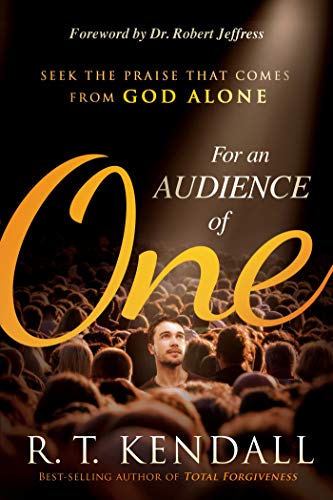
For an Audience of One 
Copyright 2020 by R. T. Kendall 
Charisma House 


Chapter One: What’s in it for God?

Pg 4

When we pursue the glory of God, we must remember we are pursuing whatever glorifies, honours, and pleases Him. This means we must personally bow out entirely and respect what He is pleased to do. Whenever He is pleased to do it. Wherever He is pleased to do it. With whomever He is pleased to use. We need to be willing to affirm His right to pass us by and bless those He chooses to bless – even when that blessing does not include what he hoped for.


Chapter Two: Knowing that God knows.

Pg 16

If you are like me, one of the most common faults we make is to run ahead of the Lord. Joseph and Mary did this. They went a whole day’s journey, “thinking he was in their company” (Luke 2:44), but He wasn’t. It is so easy to assume the Lord approves our plans merely because we truly want to please Him, because we have spent time with Him, and have even sensed His approval in so much of what we do. And yet, it is still very possible to go ahead of Him, thinking that He is behind our plans. When we move ahead like this, we are on our own. It is a precarious place to be!


Chapter Four: The Greatest Goal on Earth

Pg 55

People sometimes ask me, “How could the Jews be so blind that they missed the very Messiah promised to them?” Good question. But Jesus’ question to the Jews answers that and tells you exactly why they missed Him: the fear of man. Jesus wept over the city of Jerusalem because of it, knowing that the Jews were forfeiting what would have brought them peace: they did not “recognize the time of God’s coming” to them.


But this verse is equally relevant to you and me today. There is a grave principle that lies behind John 5:44; it not only shows how Israel missed their Messiah but all shows how you and I can miss what God is in today.


… If we are addicted to the approval of people, we quench the Holy Spirit; it is perhaps the quickest way to put out Spirit’s fire (1 Thess. 5:19)


Pg. 57

Referring to parable in Luke 17:7-10

“Suppose one of you has a servant plowing or looking after the sheep. Will he say to the servant when he comes in from the field, ‘Come along now and sit down to eat’? Won’t he rather say, ‘Prepare my supper, get yourself ready and wait on me while I eat and drink; after that you may eat and drink’? Will he thank the servant because he did what he was told to do? 10 So you also, when you have done everything you were told to do, should say, ‘We are unworthy servants; we have only done our duty.’”


This parable leaves no room for us to think God is going to give us a pat on the back each time we do something that He has commanded us to do. This parable removes all ground of entitlement. This tells me therefore that we are commanded to seek the glory that comes from the only God – on and on and on –without knowing in the meantime to what extent He is happy with us. I choose to believe that He is pleased – I am sure that He is. But the honour, praise, and glory that is implied in John 5:44 is only guaranteed at the judgement seat of Christ, and not before.


Chapter Five: Integrity

Pg. 76

Jackie Pullinger, who has become a legend in her own time because of her ministry in Hong Kong, said … “We are going to feel stupid for eternity if we waste this life.” I know what she means by that. Oh yes, God will wipe away all tears (Rev. 21:4), no doubt about that. But at the same time, at least when we stand before the judgement seat of Christ to give account of the things done in the body, whether good or bad, we will have cause to regret with incalculable sorrow if we have not found our nice to live for God’s glory on this earth.


Pg. 89

There are passages in the Bible, Old Testament and New Testament, that doesn’t make sense to us. It will be to our folly if we dismiss these merely because they don’t make sense to us – as if our opinion is valid and lets us off the hook because we deem ourselves capable of judging God’s Word. He knows what He has written. He has not forgotten what He has written. His word is a test whether we will believe His Word or dismiss it because it does not make sense to us.


Chapter Seven: Character and Gifting.

In this chapter, R. T. Kendall debated the importance of Gifting and Character.

He pointed on the example of King Saul, who “flourished despite his personal character”, and suggested that “the gifts and calling of God are irrevocable (Romans 11:29, “without repentance”, KJV). This means that a gift, once bestowed, is yours to keep, regardless of your integrity or character. – Pg 116


As a contrast, R.T. Kendall used John the Baptist as example.*

Pg. 119

He performed no miracles. Indeed, “many people came to him”. …. John the Baptist had an anointing that attracted people to come twenty miles from Jerusalem to hear him. It was the fear of God that emanated from John’s preaching.


But cannot a person who pleases the Lord by his or her holy life have both? Cannot a man of God also have such an irrevocable gift? Absolutely, if God grants it. We should pray for this (1 Cor. 12:31). But in my opinion, we should never settle for a gift that is not matched by sexual purity, detachment from the love of money, and true humility.


I would urge the reader of this book to covet the kind of anointing that comes from the desire to perform before an audience of One.


Chapter Eight: The Faith Hall of Fame.

Pg 134

From all the figures mentioned in this chapter, Joshua stood out to me.*


Likewise Joshua, Moses’ successor, showed the same reverence to God’s ways. When he saw an awesome figure – a man with a drawn sword in his hand – Joshua asked, “Are you for us or for our enemies?” The surprising answer: “Neither… but as commander of the army of the Lord.” Instead of objecting or complaining, Joshua fell on his face. He took off his shoes for he was on holy ground (Joshua 5:13-15). This scenario is a perfect demonstration of what I referred to earlier: the only evidence that I have seen the Divine Glory is my willingness to forsake any claim upon God. Joshua saw the Lord’s glory. He knew he had no claim upon  God. God owed him singularly nothing. Joshua accepted this and worshipped.


Pg 148

Caution: never – ever – presume that your faithfulness to God by being devoted to an audience of One is a guarantee of blessing, prosperity, health, happiness and safety. …


Sometimes it would seem Satan has a temporary victory. In any case, you and I must not live before an audience of One because it will guarantee a blessing. But I can, however, tell you what it will guarantee: a reward at the judgement seat of Christ.


Chapter Nine: A Spark

Pg. 169

I have wondered what kind of vulnerability it might take that you and I would be a spark today. Are we so orderly ad sophisticated that our usual way of doing things will out the Spirit’s fire?


Would you be vulnerable? Would I?

* my sentence

Saturday, November 16, 2019


The Reason for God
Timothy Keller
Penguin Group (USA) Inc., 2008


CHAPTER 5: How Can a Living God Send People to Hell?
Pg. 77
Hell, then, is the trajectory of a soul, a self-absorbed, self-centred life, going on and on forever.
Jesus’s parable of Lazarus and the Rich man in Luke 16 supports the view of hell we are presenting here. Lazarus is a poor man who begs at the gate of a cruel rich man. They both die and Lazarus goes to heaven while the rich man goes to hell. There he looks up and sees Lazarus in heaven ‘ín Abraham’s bosom’:

24 So he called to him, ‘Father Abraham, have pity on me and send Lazarus to dip the tip of his finger in water and cool my tongue, because I am in agony in this fire.’
25 “But Abraham replied, ‘Son, remember that in your lifetime you received your good things, while Lazarus received bad things, but now he is comforted here and you are in agony. 26 And besides all this, between us and you a great chasm has been set in place, so that those who want to go from here to you cannot, nor can anyone cross over from there to us.’
27 “He answered, ‘Then I beg you, father, send Lazarus to my family, 28 for I have five brothers. Let him warn them, so that they will not also come to this place of torment.’
29 “Abraham replied, ‘They have Moses and the Prophets; let them listen to them.’
30 “‘No, father Abraham,’ he said, ‘but if someone from the dead goes to them, they will repent.’
31 “He said to him, ‘If they do not listen to Moses and the Prophets, they will not be convinced even if someone rises from the dead.’” (Luke 16:24-31)

What is astonishing is that though their statuses have now been reversed, the rich man seems to be blind to what has happened. He still expects Lazarus to be his servant and treats him as his water boy. He does not ask to get out of hell, yet strongly implies that God never gave him and his family enough information about the afterlife.

Commentators have noted the astonishing amount of denial, blame-shifting and spiritual blindness in this soul in hell. They have also noted that the rich man, unlike Lazarus, is never given the personal name. He is called a ‘Rich Man’, strongly hinting that since he had built his identity on his wealth rather than God, once he lost his wealth he lost any sense of a self.

In his fantasy The Great Divorce, C.S. Lewis describes a busload of people from hell who come to the outskirts of heaven. There they are urged to leave behind the sins that have trapped them in hell – but they refuse. Lewis’s descriptions of these people are striking because we recognise in them the self-delusion and self-absorption that are ‘writ small’ in our own addictions.

The people in hell are miserable, but Lewis shows us why. We see raging like unchecked flames their pride, their paranoia, their self-pity, their certainty that everyone else is wrong, that everyone else is an idiot! All their humility is gone, and thus so is their sanity. They are utterly, finally locked in a prison of their own self-centredness, and their pride progressively expands into a bigger and bigger mushroom cloud. They continue to go to pieces for ever, blaming everyone but themselves. Hell is that, writ large.


CHAPTER 10: The Problem of Sin
Pg 166.
As a pastor at my first church in Hopewell, Virginia, I found myself counselling two different women, both of whom were married, both of whom had husbands who were poor fathers, and both of who had teenage sons who were beginning to get into trouble in school and with the law. Both of the women were angry at their husbands. I advised them and talked (among other things) about the problems of unresolved bitterness and the importance of forgiveness. Both women agreed and sought to forgive. However, the woman who had the worst husband and who was the least religious was able to forgive. The other woman was not. This puzzled me for months until one day the unforgiving woman blurted out, ‘Well if my son goes down the drain then my whole life will have been a failure!’ She had centered her life on her son’s happiness and success. That was why she couldn’t forgive.

CHAPTER 12: The (true) Story of The Cross

Consider parenting. Children come into the world in a condition of complete dependence. They cannot operate as a self-sufficient, independent agents unless their parents give up much of their own independence and freedom for years. If you don’t allow your children to hinder your freedom in work and play at all, and if you only get to your children when it doesn’t inconvenience you, your children will grow up physically only. In all sorts of other ways they will remain emotionally needy, troubled and overdependent. The choice is clear. You can either sacrifice your freedom or theirs. It’s them or you. To love your children well, you must decrease that they may increase. You must be willing to enter into the dependency they have so eventually they can experience the freedom and independence you have.

Chapter 14: The Dance of God

Pg. 220 The future of the dance
How, then, will the story of human history end?  At the end of the final book of the Bible, we see the very opposite of what other religions predict. We do not see the illusion of the world melt away nor do we see spiritual souls escaping the physical world into heaven. Rather, we see heaven descending into our world to unite with it and purity it of all its brokenness and imperfection. It will be a ‘new heavens and a new earth’.

Pg. 221 Returning to the Dance.
However, when we discern Jesus moving toward us and encircling us with an infinite, self-giving love, we are invited to put our lives on a whole new foundation. We can make him the new center of our lives and stop trying to be our own Savior and Lord. We can accept both his challenge to recognize ourselves as sinners in need of his salvation, and his renewing love as the new basis of our identity. Then we don’t need to prove ourselves to others. We won’t need to use others to bolster our fragile sense of pride and self-worth. And we will be enabled to move out toward others as Jesus has moved towards us.